
Read the story
Context
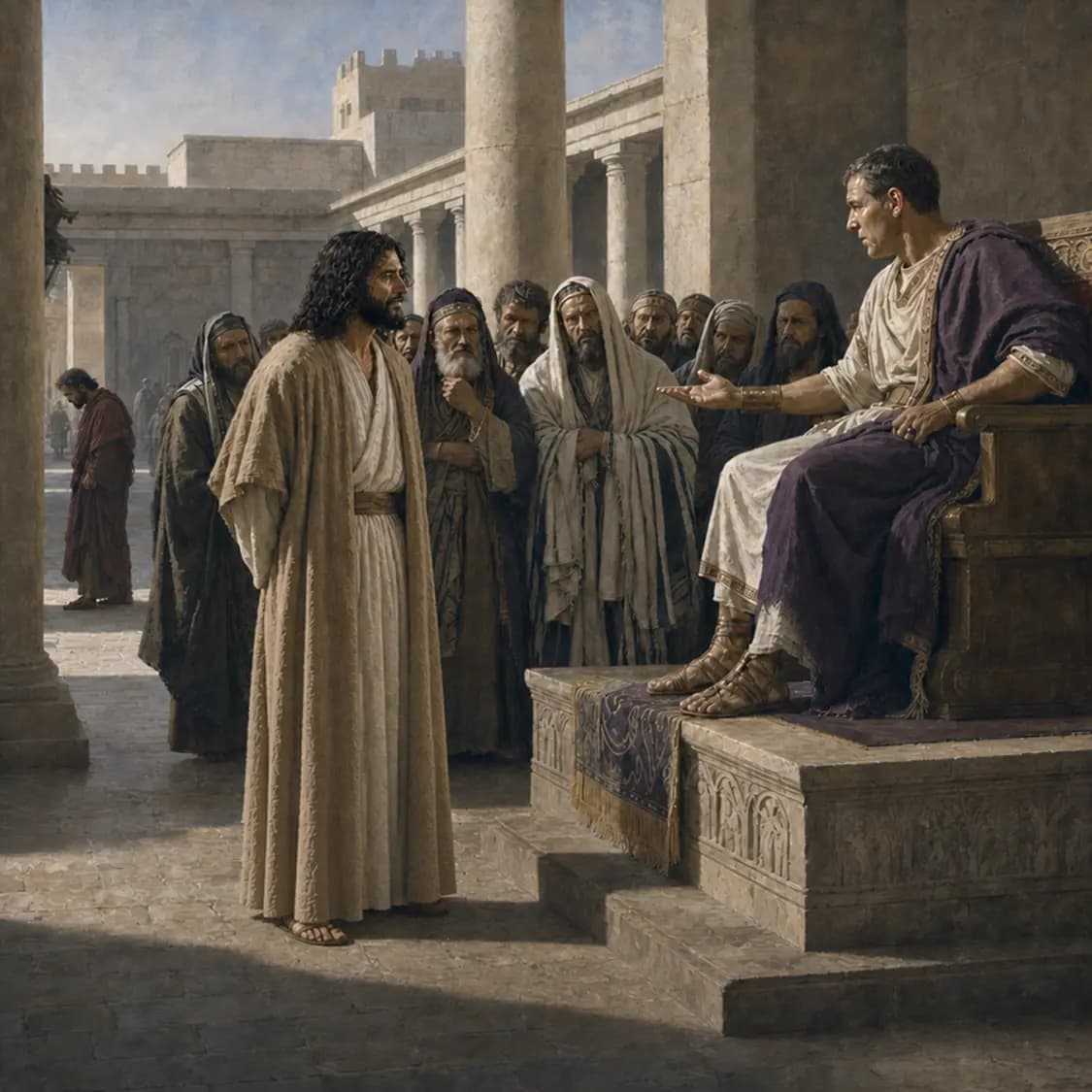
Jerusalem was under Roman rule, and Pilate was the Roman official before whom Jesus’ accusers brought their case. Herod governed Galilee and was also in Jerusalem. Different rulers held authority over different parts of the region.
A claim to kingship could sound like a challenge to Caesar, so the charges against Jesus were presented as matters of public order and political loyalty. The central question was whether any charge deserving death could be established against him.
Story
The assembled group rose and led Jesus to Pilate. Before the Roman ruler, they framed their accusations in political terms. They charged Jesus with misleading the nation, opposing the payment of taxes to Caesar, and claiming to be the Messiah, a king.
Pilate focused on the question of kingship.
“Are you the king of the Jews?”
Jesus answered, “You say so.” Pilate then told the chief priests and the crowd that he found no basis for a charge against Jesus.
The accusers became more insistent. They said Jesus was stirring up the people by teaching throughout Judea, beginning in Galilee and continuing all the way to Jerusalem.
When Pilate heard about Galilee, he asked whether Jesus was a Galilean. After confirming that Jesus came under Herod’s jurisdiction, Pilate sent him to Herod, who was also in Jerusalem at the time.
Herod was very pleased to see Jesus. He had heard much about him and had wanted to meet him for a long time. He hoped to witness Jesus perform a miracle. Herod questioned him at length, but Jesus gave him no answer. Meanwhile, the chief priests and teachers of the law stood nearby, forcefully repeating their accusations.
Herod and his soldiers treated Jesus with contempt and mocked him. They dressed him in a splendid robe and sent him back to Pilate. Although Herod and Pilate had previously been hostile toward each other, they became friends that day.
Pilate called together the chief priests, the rulers, and the gathered people. He reminded them that they had accused Jesus of inciting the people. Yet after examining him, Pilate had found no basis for their charges. Herod had found nothing deserving death either. Even so, Pilate proposed having Jesus punished and then releasing him.
Those assembled cried out together, demanding that Jesus be taken away and that Barabbas be released instead. Barabbas was in prison because of an uprising in the city and for murder.
Pilate wanted to release Jesus, so he appealed to them again. Their answer was loud and direct:
“Crucify him! Crucify him!”
Pilate addressed them a third time. He asked what crime Jesus had committed and again declared that he had found nothing deserving death. Once more, he proposed punishing Jesus and then letting him go.
But they continued shouting and demanding crucifixion. Their voices prevailed. Pilate issued the sentence they demanded. He released Barabbas, the man imprisoned for rebellion and murder, and handed Jesus over to their will.
What We Learned
- Neither Pilate nor Herod found Jesus guilty of anything deserving death. His sentence came despite the acknowledged lack of a case against him.
- Jesus would not turn Herod’s curiosity into a performance. Herod wanted a miracle, but Jesus answered none of his questions.
- Pilate shows that recognizing what is right is not the same as doing it. He wanted to release Jesus, yet allowed pressure to determine his judgment.
- The release of Barabbas makes the injustice unmistakable: a man imprisoned for rebellion and murder went free, while Jesus was handed over.
Story background
Jesus Before Pilate is read in Luke 23:1-25. The assembly brings Jesus before Pilate and charges him with misleading the nation, opposing taxes to Caesar, and claiming to be Messiah, a king. The account also draws attention to justice and injustice and Jesus’ kingship. Its named people, setting, and sequence matter, while details not stated in the passage should remain open rather than being supplied from later retellings. Read the scene in its surrounding movement: notice what prompts the action, how the central figures respond, and what the final words leave with the hearer. This background keeps the story close to its explicit claims while making room for careful reflection on justice and injustice, Jesus’ kingship, and the other themes named here. The passage can be revisited slowly, with its questions and tensions intact.
People in the story
- Jesus — Stands before Pilate and Herod under political accusations
- Pilate — Questions Jesus, finds no basis for a charge, and finally yields to the crowd’s demand
- Herod — Questions and mocks Jesus, then returns him to Pilate
- Chief priests, rulers, and crowd — Press the accusations and demand Barabbas’s release and Jesus’ crucifixion
- Barabbas — Prisoner released in place of Jesus
Themes to notice
Justice and injustice
The passage brings justice and injustice into focus through its named people, actions, and ending.
Jesus’ kingship
The passage brings Jesus’ kingship into focus through its named people, actions, and ending.
Political pressure
The passage brings political pressure into focus through its named people, actions, and ending.
Human responsibility
The passage brings human responsibility into focus through its named people, actions, and ending.
Questions for reflection
- What stands out to you about justice and injustice in this passage?
- How do the people in the story respond to Jesus’ kingship?
- Which detail would you want to read again in its wider context?
- What question does this account leave you carrying?
Related stories



Carry the story with you
Save your reflections on jesus before pilate and revisit them as you continue through Scripture.