
Read the story
Context
Gethsemane stands at the threshold of Jesus’s arrest. Judas’s identity matters here: he is one of the Twelve, not an outside enemy but one of Jesus’s own followers. His role in what follows is therefore betrayal, not merely opposition.
When Jesus speaks of “the hour” and “the cup,” both refer to the suffering before him. They name the burden he is about to bring before his Father in prayer.
Story
When Jesus and his disciples arrived at Gethsemane, he told most of them to sit while he went to pray. He took Peter, James, and John farther with him. Then he became deeply distressed and troubled.
“My soul is overwhelmed with sorrow to the point of death,” he told them. He asked them to stay there and keep watch.
Going a little farther, Jesus fell to the ground and prayed that, if it were possible, the approaching hour might pass from him. He acknowledged that all things were possible for his Father and asked for the cup to be taken away. Yet his prayer ended in submission:
“Not what I will, but what you will.”
Jesus returned to the three disciples and found them asleep. Addressing Peter as Simon, he asked whether he had been unable to keep watch for even one hour. Then he warned them to watch and pray so that they would not fall into temptation. Their intentions might be willing, but their human weakness was real.
Jesus went away again and prayed the same request. When he returned, the disciples were asleep once more because their eyes were heavy. They did not know what to say to him.
On his third return, Jesus brought the waiting to an end. The hour had come. The Son of Man was being betrayed into the hands of sinners. He told the disciples to rise because his betrayer was near.
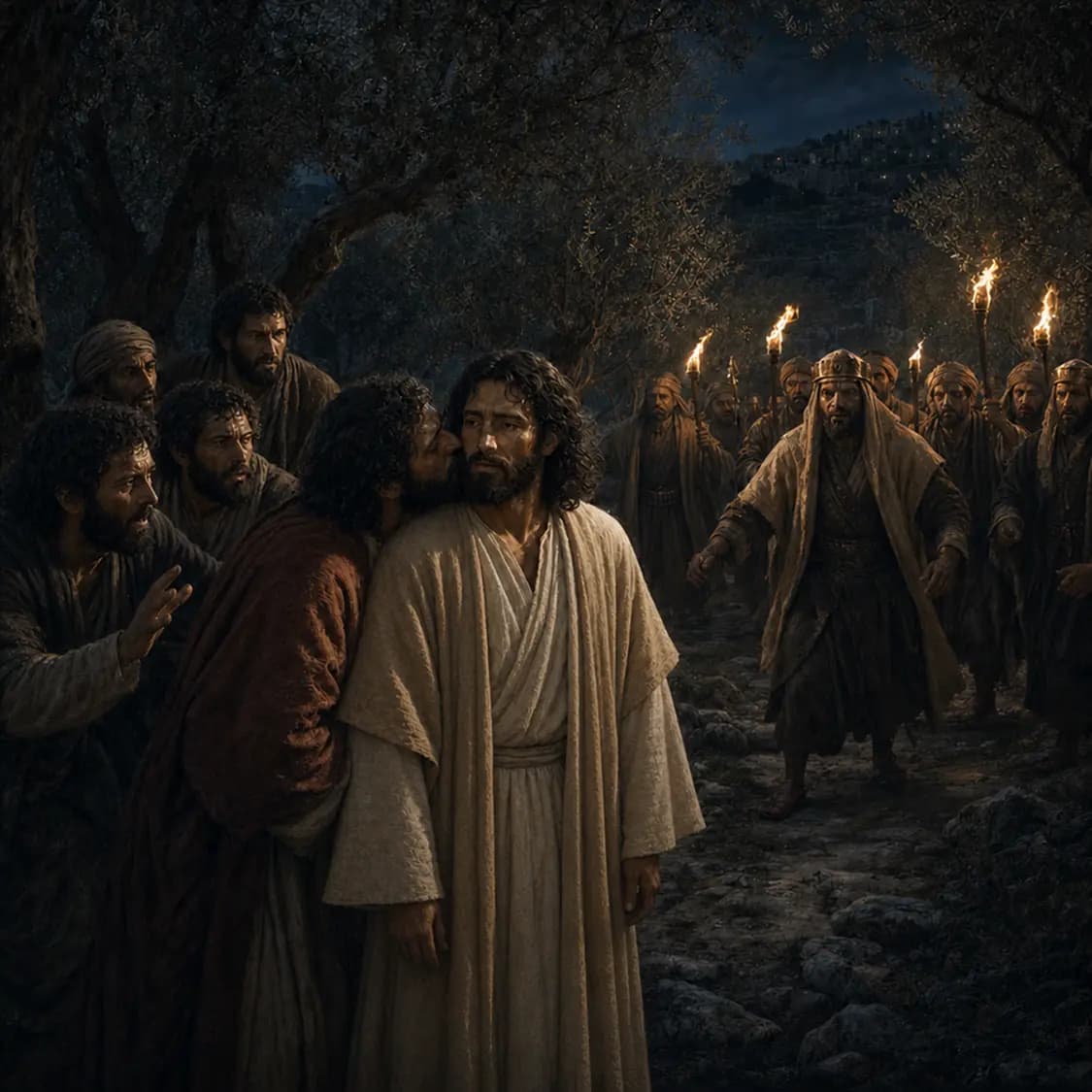
While Jesus was still speaking, Judas arrived. With him came a large crowd carrying swords and clubs, sent by the chief priests, the teachers of the law, and the elders.
Judas had arranged a signal with them. The man he kissed would be Jesus, and they were to arrest that man and lead him away. Judas went directly to Jesus, greeted him as his teacher, and kissed him.
The crowd seized Jesus and arrested him.
One of those standing nearby drew a sword and struck the servant of the high priest, cutting off his ear. Jesus then challenged the way the crowd had come for him. Why had they arrived with swords and clubs, as though they were seizing a robber? Day after day he had been among them, teaching openly in the temple, yet they had not arrested him there. Still, Jesus said that the Scriptures had to be fulfilled.
Then all his disciples abandoned him and fled.
A certain young man had been following Jesus, wearing only a linen cloth around his body. When the men seized him, he left the cloth behind and fled from them naked.
What We Learned
- Jesus shows that deep anguish can be brought honestly to God in prayer.
- Trust does not deny suffering. Jesus asks for the cup to pass, yet submits himself to his Father’s will.
- The sleeping disciples reveal why watchfulness and prayer matter: sincere intentions do not remove human weakness.
- Jesus challenges the manner of his arrest while recognizing that these events remain within the purpose revealed in Scripture.
- Judas’s betrayal and the disciples’ flight show how quickly human loyalty can fail under pressure.
Story background
Jesus Prays in Gethsemane and Is Arrested is read in Mark 14:32-52. At Gethsemane, Jesus asks the disciples to sit while he takes Peter, James, and John farther with him. The account also draws attention to prayer and submission. Its named people, setting, and sequence matter, while details not stated in the passage should remain open rather than being supplied from later retellings. Read the scene in its surrounding movement: notice what prompts the action, how the central figures respond, and what the final words leave with the hearer. This background keeps the story close to its explicit claims while making room for careful reflection on prayer, submission, and the other themes named here. The passage can be revisited slowly, with its questions and tensions intact.
People in the story
- Jesus — Prays in anguish and submission, warns the disciples, and is arrested
- Peter, James, and John — Accompany Jesus farther into Gethsemane but repeatedly fall asleep
- Judas Iscariot — Betrays Jesus with an arranged kiss
- Arresting crowd — Comes armed on behalf of the religious authorities and seizes Jesus
- Young man — Follows Jesus and escapes when seized
Themes to notice
Prayer
The passage brings prayer into focus through its named people, actions, and ending.
Submission
The passage brings submission into focus through its named people, actions, and ending.
Watchfulness
The passage brings watchfulness into focus through its named people, actions, and ending.
Betrayal
The passage brings betrayal into focus through its named people, actions, and ending.
Questions for reflection
- What stands out to you about prayer in this passage?
- How do the people in the story respond to submission?
- Which detail would you want to read again in its wider context?
- What question does this account leave you carrying?
Related stories

Carry the story with you
Save your reflections on jesus prays in gethsemane and is arrested and revisit them as you continue through Scripture.