
Read the story
Context
As the message about Jesus spread, Stephen became known as a follower of Jesus who was full of faith and spiritual power. His public work drew opposition from people who challenged what he was teaching.
The conflict soon became more than a debate. Stephen was accused of dishonoring Moses, God, the law, and the holy place—serious charges that brought him before the council. There, his accusers and his judges would hear a direct challenge about what it truly meant to listen to God.
Story
Among the people, Stephen performed great wonders and signs. Opposition arose among members of the Synagogue of the Freedmen—people from Cyrene and Alexandria, as well as Cilicia and Asia. They began debating with Stephen, but they could not overcome the wisdom and the Spirit with which he spoke.
Some of his opponents then secretly persuaded men to claim that Stephen had spoken blasphemously against Moses and God. They stirred up the people, the elders, and the teachers of the law. Stephen was seized and brought before the council.
There, false witnesses accused him of continually speaking against the holy place and the law. They claimed that they had heard him say Jesus of Nazareth would destroy the place and change the customs handed down by Moses.
Everyone seated in the council looked steadily at Stephen. His face appeared like the face of an angel.
Stephen’s response ended with a direct rebuke. He told his hearers that they were stubborn, with hearts and ears closed to God. “You always resist the Holy Spirit,” he said, just as their ancestors had done. Their ancestors had persecuted the prophets, including those who foretold the coming of the Righteous One. Now, Stephen charged his hearers with betraying and killing that Righteous One. Though they had received God’s law, delivered through angels, they had not obeyed it.
Stephen had been accused of opposing the law. Now he accused his judges of failing to keep the very law they claimed to defend.
When they heard this, they became furious and ground their teeth at him. Stephen, still full of the Holy Spirit, looked steadily into heaven. In a vision, he saw the glory of God and Jesus standing at God’s right hand.
He announced, “I see heaven open and the Son of Man standing at the right hand of God.”
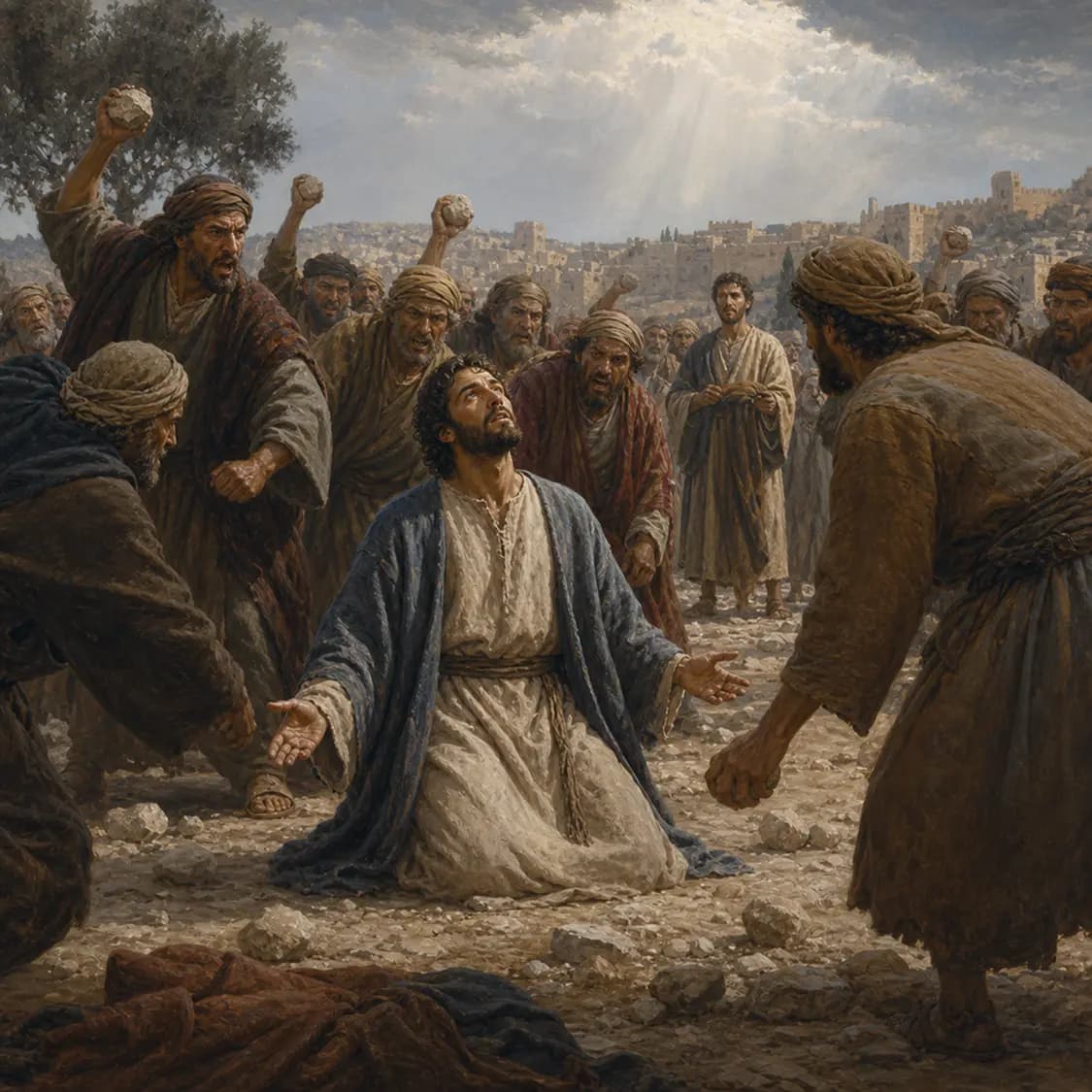
His hearers shouted, covered their ears, and rushed at him together. They cast him outside the city and stoned him. The witnesses laid their outer garments at the feet of a young man named Saul.
As they stoned Stephen, he called out, “Lord Jesus, receive my spirit.” Then he knelt and cried in a loud voice, “Lord, do not hold this sin against them.”
After saying this, Stephen died.
What We Learned
- Stephen’s wisdom came through the Holy Spirit, yet Spirit-given truth was still met with false accusations and rejection.
- Using sacred language is not the same as obeying God. Stephen’s accusers claimed to defend the law while refusing his challenge to hear what God was saying.
- Stephen’s vision presents Jesus alive and honored at God’s right hand, and Stephen entrusted his life to him.
- Even while facing violence, Stephen prayed for mercy toward those attacking him. His final witness joined courage with forgiveness.
Story background
Stephen’s Witness and Martyrdom is read in Acts 6:8-15, Acts 7:1-60. Stephen, full of grace and power, faces opposition from people who cannot withstand the wisdom and Spirit with which he speaks. The account also draws attention to witness under opposition and resisting or hearing God's Spirit. Its named people, setting, and sequence matter, while details not stated in the passage should remain open rather than being supplied from later retellings. Read the scene in its surrounding movement: notice what prompts the action, how the central figures respond, and what the final words leave with the hearer. This background keeps the story close to its explicit claims while making room for careful reflection on witness under opposition, resisting or hearing God's Spirit, and the other themes named here. The passage can be revisited slowly, with its questions and tensions intact.
People in the story
- Stephen — Witness, council speaker, and martyr who prays for those stoning him
- Council members and false witnesses — Accuse Stephen and react violently to his vision and speech
- Jesus, the Son of Man — Seen by Stephen standing at God's right hand
- Saul — A young man at whose feet the witnesses lay their garments
Themes to notice
Witness under opposition
The passage brings witness under opposition into focus through its named people, actions, and ending.
Resisting or hearing God's Spirit
The passage brings resisting or hearing God's Spirit into focus through its named people, actions, and ending.
Jesus' exaltation
The passage brings Jesus' exaltation into focus through its named people, actions, and ending.
Forgiveness amid violence
The passage brings forgiveness amid violence into focus through its named people, actions, and ending.
Questions for reflection
- What stands out to you about witness under opposition in this passage?
- How do the people in the story respond to resisting or hearing God's Spirit?
- Which detail would you want to read again in its wider context?
- What question does this account leave you carrying?
Related stories
Carry the story with you
Save your reflections on stephen’s witness and martyrdom and revisit them as you continue through Scripture.