


You sit down with a passage you have read before, and this time a single sentence stops you. The words are plain enough, yet the meaning feels just out of reach, and the verse you remember from somewhere else seems to say something slightly different. Most readers meet this moment sooner or later, and it is a good place to begin learning how to understand the Bible.
The way forward is a steady sequence: read a complete unit of thought, widen the circle of context around it, notice what kind of writing you are holding, and ask questions that separate what the text says from what it means. Then carry your application with patience, knowing that some questions take time and that careful readers sometimes reach different conclusions. None of this requires special training. It requires attention, a little structure, and a willingness to return.
Start with a complete unit of thought
A verse marker helps you locate a line. Begin by reading the paragraph, scene, or argument that holds it. A complete unit supplies the speaker, audience, and movement that a single line cannot carry on its own. When you isolate one verse from its neighbors, you often cut a sentence off in the middle of its own thought.
What counts as a unit
Look for a section with a beginning and an end: a paragraph in a letter, a full scene in a narrative, a complete psalm, a self-contained instruction. Section headings can offer a useful first guess, then test the boundary by reading across it. If the thought flows straight through, the unit continues; if a new speaker, setting, or step in the argument begins, you have found the seam.
Reading the whole unit before zooming in protects you from a common misstep: building an interpretation on a phrase the passage itself was about to qualify. An argument in a letter may pose a question and answer it several sentences later. A story may describe an action without endorsing it, and the next scene shows the consequences. The complete unit carries information that the single line cannot.
A simple first pass
Read the unit once without writing anything down. Just follow the movement: who is present, what changes, where the tension sits. Then read it again with a pencil ready, and mark the seams — a shift in speaker, a new setting, a turn in the argument. Those seams tell you how the passage is put together, and how it is put together shapes what it can mean.
Read the context in widening circles
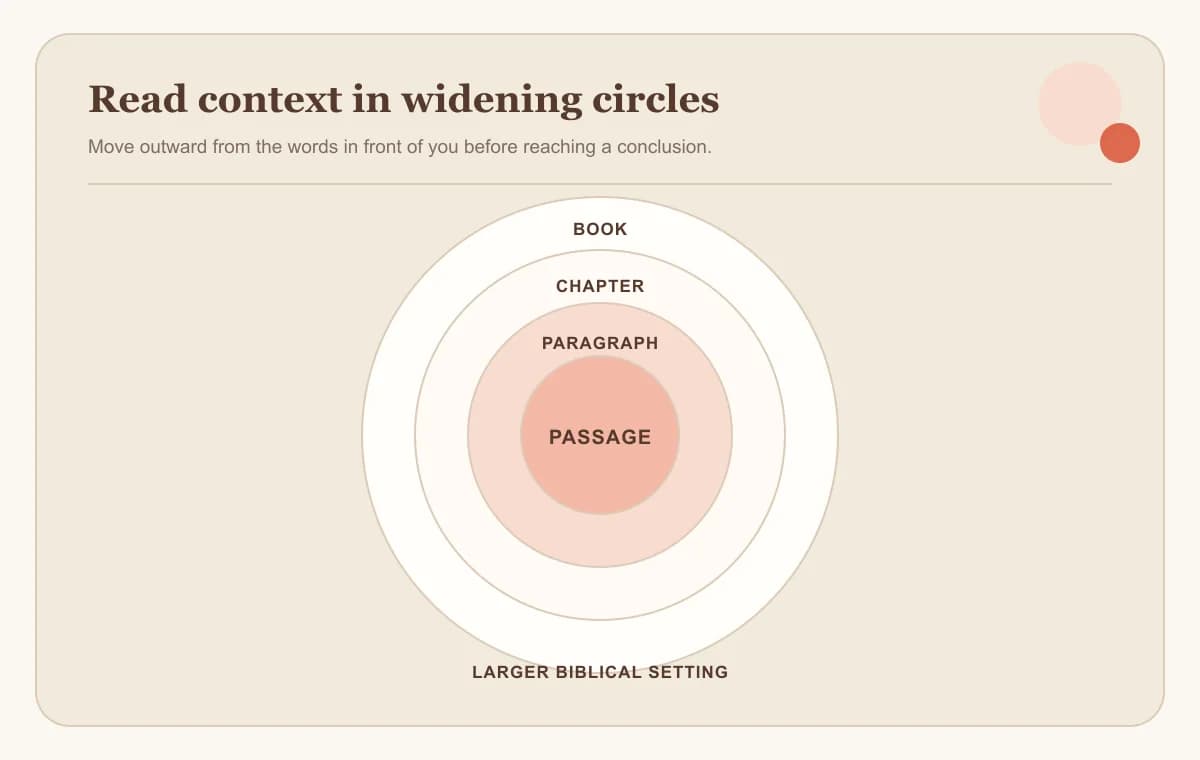
Once the unit is in view, look outward in layers. Context works like concentric rings: the closest ring matters most, and each wider ring adds perspective without replacing the one inside it.
The immediate ring: the surrounding sentences
The verses before and after your passage answer the most urgent questions. Who is speaking, and to whom? What problem prompted these words? Is the author describing something that happened, commanding something to happen, or lamenting something that should never have happened? Many confusing lines become clearer within their own paragraph, because the author usually explains more than a quick reading assumes.
The middle ring: the chapter and the book
Every passage belongs to a book with a purpose, an audience, and a shape. A sentence in the middle of a Gospel gains depth when you know where the story is heading. A command in a letter reads differently once you know what had gone wrong in the community receiving it. Ask what this book is doing as a whole, then ask how your unit serves that larger aim.
The wide ring: the whole story
The Bible is a library gathered around one long narrative. Passages echo and answer one another across that library, and themes introduced early return in new forms. This widest ring is where careful readers spend years, and it rewards patience. You do not need to master it before reading well. You only need to remember it exists, so that a confident claim about one line gets tested against the whole.
Notice what kind of writing you are reading
The Bible contains narrative, poetry, wisdom sayings, legal instruction, prophecy, and letters, and each kind of writing uses a different form. A psalm speaks in images and parallel lines, so read it the way you read a poem and let the pictures do their work. A wisdom saying gives you a short, compressed observation, so ask what situation it fits and what it leaves unsaid. A narrative shows what happened, and description does not automatically become instruction.
You can begin with one honest question: what is this piece of writing doing? Is it telling a story, singing a prayer, building an argument, giving a law, warning a nation, comforting a church? The answer sets the terms for every question that follows. It also tells you what kind of confidence is appropriate. A clear narrative statement about what occurred carries a different reading posture than a dense prophetic image that invites more than one careful reading.
Use questions that separate observation from interpretation
The most useful habit in Bible study is also one of the quietest: keep your observations and your interpretations in different columns. Observation names what is present in the text. Interpretation proposes what it means. Application decides how to respond. Trouble begins when these three collapse into one, because an untested first impression can start acting like a fact.
A simple question ladder
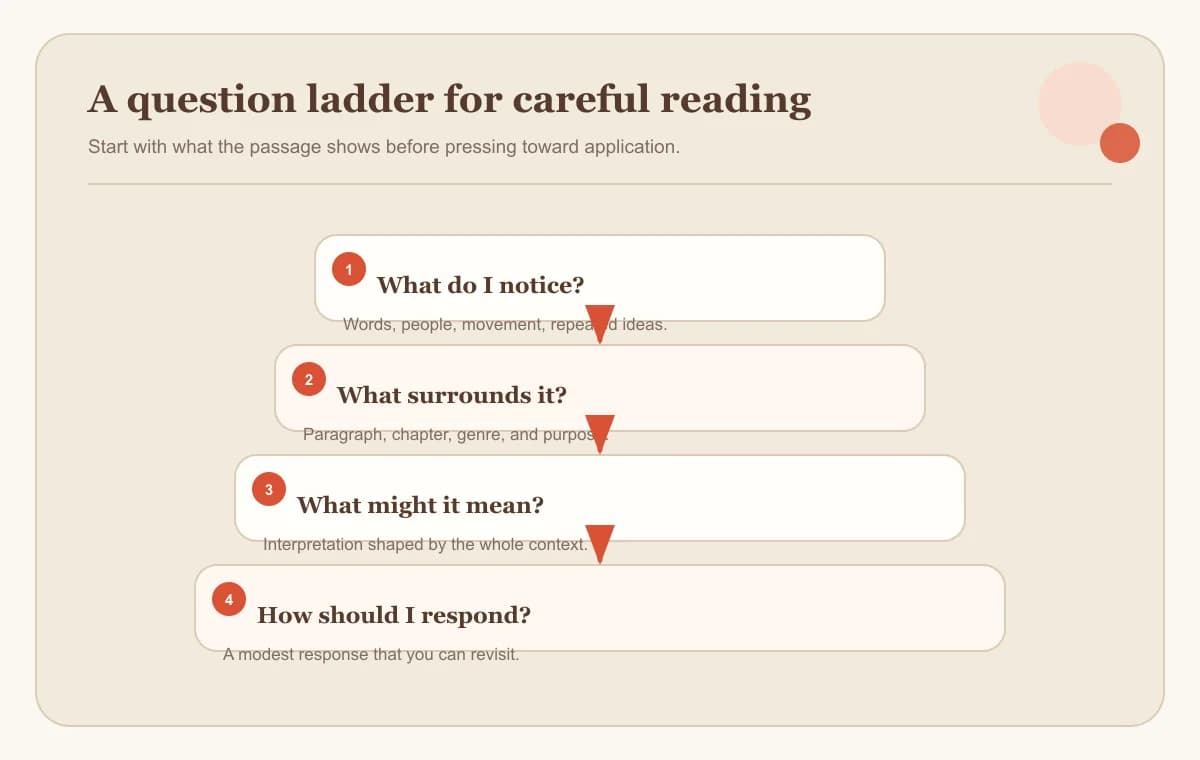
Climb four steps, in order, and write your answers down:
Observation: What does the text say? Repeated words, contrasts, commands, characters, sequence, setting. Only things you can point to on the page.
Context: What do the surrounding unit, the book, and the kind of writing tell me about how to read this?
Interpretation: What did this most likely mean for its first audience, and what is the author's main point here? Hold your answer as a proposal you are willing to test.
Application: Given that meaning, what response fits my life this week — something small, specific, and connected to what I observed?
The ladder slows you down in the right places. It also gives you an honest place to park a hard question: a question mark under interpretation gives you a precise next question for the next reading or conversation.
A written method makes this ladder easier to keep. The Bible note method shows how to keep references, observations, and responses together on one page, and the SOAP Bible study method gives the same instinct a short four-part rhythm you can finish in a sitting.
Bring difficult questions to a study conversation
Some questions survive every pass through the ladder. A phrase stays opaque, two passages seem to pull against each other, or the historical setting sits beyond what you can reconstruct alone. At that point a study conversation helps, and you can prepare for it by arriving with your observation and context notes already in hand.
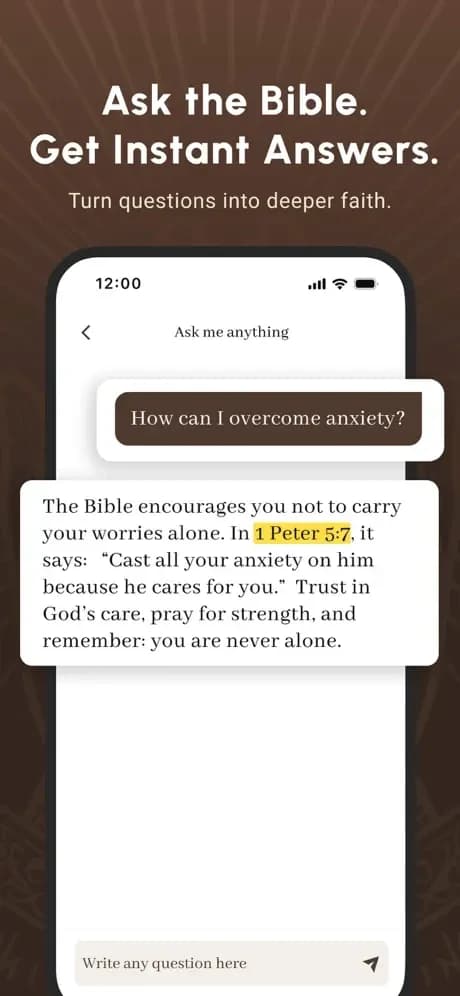
Bible Note's Bible Study Chat is built for exactly this moment. It answers from the passage you currently have open or from a sermon note, shows the cited Scripture with the translation labeled, and keeps Scripture, interpretation, and AI inference visibly separate so you can tell which is which. When an answer is worth keeping, you can save it into a Note and bring it back later.
Use the tool the way you would use a knowledgeable study partner whose work you still check. AI can be wrong. It can miss context, overstate confidence, or flatten a genuinely debated question. Read the cited verses in their own setting, weigh the interpretation against what you observed, and let the answer serve your study without concluding it for you. Bible Note Bible Study Chat is a companion for the work of reading; Scripture itself, your church, and trusted teachers hold a different and deeper authority.
Keep learning when interpretations differ
Faithful, careful Christians can read the same passage and reach different conclusions. Knowing this in advance changes how you study: you can hold a considered view with genuine conviction and still keep listening.
A few habits keep disagreement fruitful. First, locate where the difference actually sits. Two readers may agree on every observation and part ways at interpretation, or agree on meaning and differ on application. Naming the level keeps the conversation honest. Second, give the strongest form of the other reading a fair hearing before you answer it. Third, rank your confidence. Some passages carry the weight of the whole story, and your reading can settle with study. Others stay genuinely open after honest work. Hold the second kind with an open hand.
Conversation helps most here. A group that reads the same unit together will notice what a solitary reader misses, and hearing how another person arrived at a reading teaches you about your own assumptions. These small-group Bible study questions can help you frame open questions that send everyone back to the text. What matters is the shared posture: the passage stays at the center, and every reader — including you — remains a student of it.
Frequently asked questions
Where should I start if a passage confuses me?
Read the whole paragraph or scene it belongs to, then the verses before and after it. Most confusion shrinks once the unit and its immediate context are in view.
How much historical background do I need before reading?
Enough to know the book's audience and purpose. Your edition's introduction usually covers that in a page. Deeper background helps over time, yet careful reading of the text itself comes first.
What should I do when two passages seem to disagree?
Write down what each one actually says, read both in their own contexts, and note what kind of writing each is. Some tensions resolve with context; others are places where faithful readers have long held more than one view.
Can I rely on an AI Bible study tool for answers?
Use it as a study companion that can be wrong. Bible Note shows cited Scripture with the translation labeled and separates interpretation from AI inference, which makes its answers easier to check against the passage — and checking is still your job.
Sources
Editorial status
Written and edited by Hans Keller for Bible Note. Sources, Scripture context, dates, and practical limitations are checked before publication.

About the author
Hans Keller
Editorial & Content Lead
Bible Study & Sermon Learning Content Editor
Hans helps Christians turn sermons and Scripture study into clear notes, thoughtful questions, and faithful next steps.
His work helps listeners and group leaders carry a sermon or study beyond the meeting: back to the passage, into clearer questions, and toward one practical response for the week.
Read with Scripture open
Use this guide alongside the full biblical passage and the practices of your local church. Interpretive details can differ across Christian traditions.