

At the end of a full day, an open Bible can feel surprisingly large. You may have ten or fifteen minutes, a notebook you have barely used, and a quiet hope that this time will become a habit. That is enough for a real reading session: one short passage, careful attention, and one thought worth keeping.
Here is the short answer to how to read the Bible: choose one book, read a complete paragraph or scene, write down what it says and the question it raises, then return at a pace you can repeat tomorrow. This guide slows that simple rhythm down so you can put it into practice.
Bring a translation you can read comfortably, a small place to keep notes, and a modest window of time. The steps below are made for a busy week and for the reader who is beginning again.
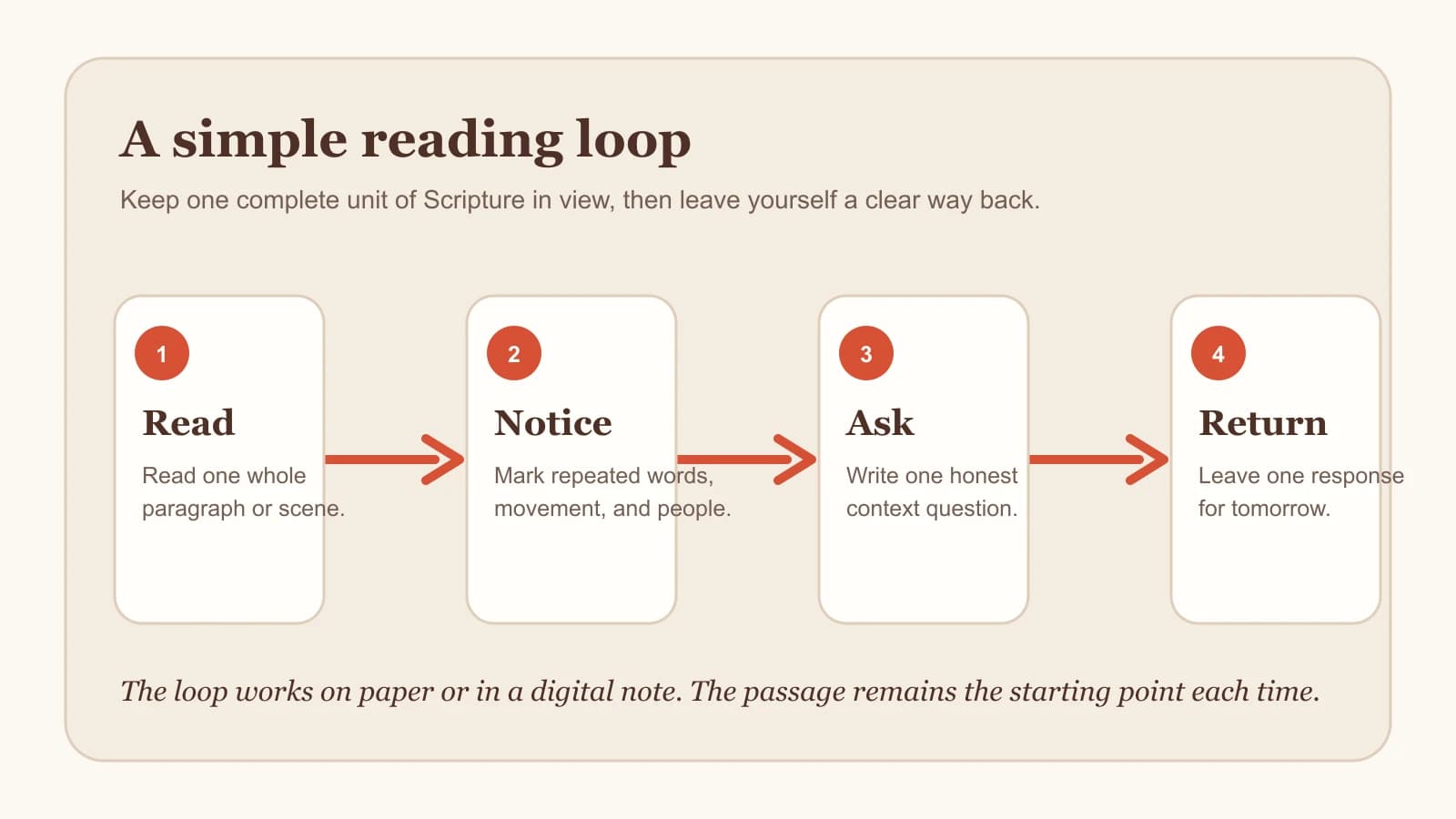
Use the same four-step sequence for your first session:
Choose one book and one complete unit. A paragraph, scene, speech, or short psalm is plenty for today.
Read the unit twice. Let the first pass give you the plain sense, then notice words, movement, and questions on the second.
Write one question and one response. Keep both beside the passage reference so they are ready when you return.
Pick up with the next natural unit tomorrow. A repeatable rhythm gives you a clear way back after a missed day.
Choose a starting book and a small stopping point
The Bible is a library, and every library has several good entrances. Choosing one book gives your reading a clear first step.
Start with a book that tells a story or speaks plainly
Many experienced readers begin with a Gospel because it gives them a person, a plot, and sayings they can follow on a first pass. Mark is short and moves quickly. Luke gives a longer, connected account of Jesus' life and teaching. Either can serve as a welcoming first book.
If narrative feels slow, Philippians is short enough to read in a few sittings and speaks in a warm, direct voice. Genesis is another good choice for readers drawn to origin stories and family history. Pick one book and stay with it long enough to notice its shape and voice.
Let the passage set your stopping point
Choose a paragraph, a scene, a speech, or a short psalm before you begin. Most printed Bibles mark paragraphs, and many add small section headings. Completing one of those units gives you a whole thought to carry into the rest of your day.
If you would appreciate help turning a book into daily portions, the Bible reading plan generator can give you a starting schedule. Keep the passage itself in view as you use it.
Read the whole paragraph before focusing on a verse
Verses often appear on mugs, in posts, and in conversations. Each verse also belongs to a paragraph, and the paragraph carries its setting. Reading the whole unit first keeps a striking sentence connected to the conversation around it.
Read it once for the plain sense
On your first pass, read the unit slowly and ask one question: what is happening here, in plain words? Who is speaking, who is listening, what just happened before this, and what happens next? Summarize the unit in one ordinary sentence, the way you would describe a scene from a film to a friend. That sentence can anchor the rest of your notes.
Read it again and notice what stands out
On the second pass, slow down further. Notice repeated words, cause and effect, contrasts, and anything that surprises you. When a verse catches your attention, write it down with its surrounding paragraph in mind. The second reading helps the passage speak beyond one familiar phrase.
Ask four questions that keep the context in view
Four steady questions can give every session a useful shape. They help you read closely without turning a short passage into an assignment.
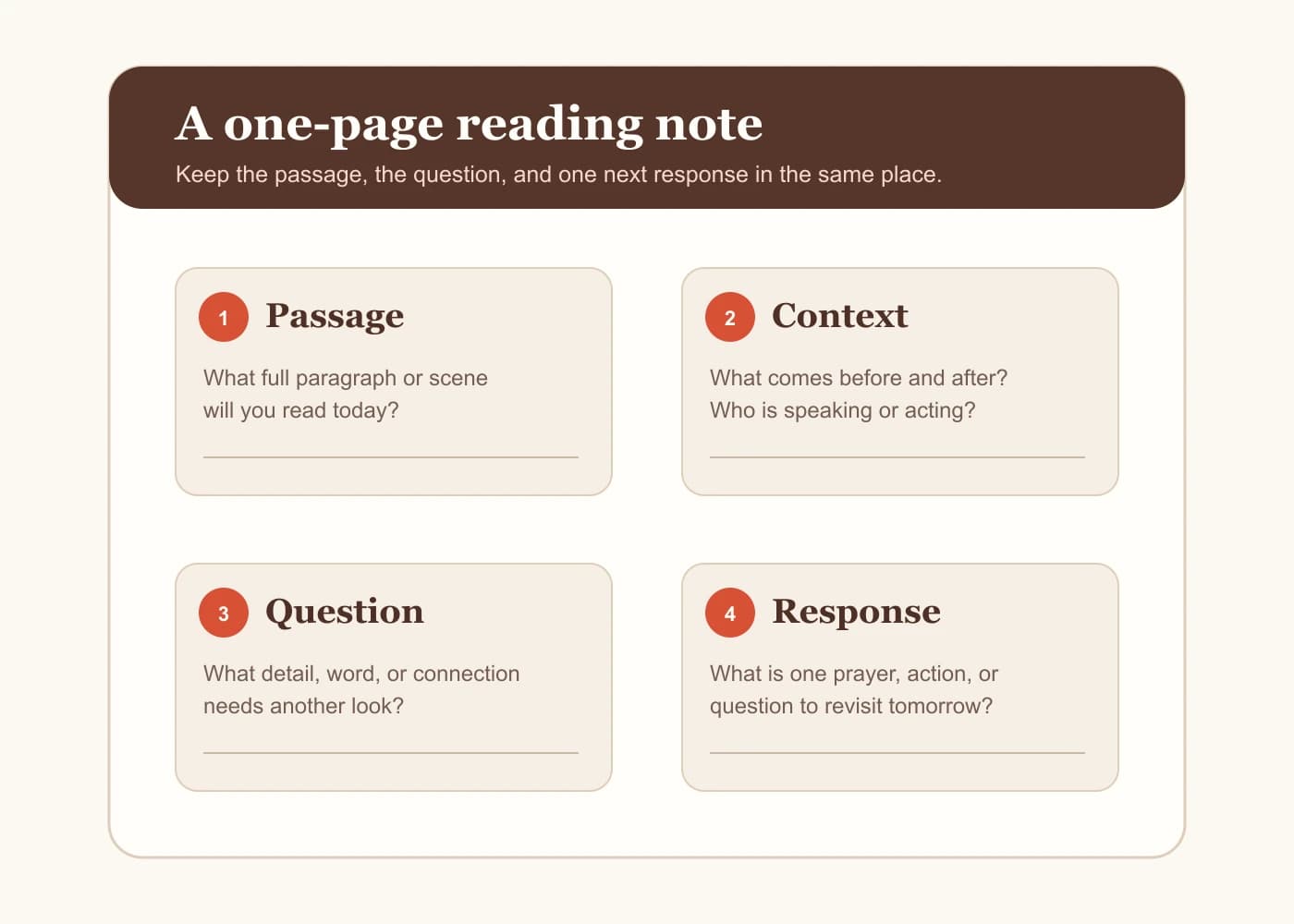
1. What does the passage actually say?
Describe the content before you interpret it. Write one or two sentences of plain summary, then read the unit again if the summary still feels blurry. This small pause keeps the passage in front of you.
2. What surrounds it?
Look one paragraph backward and one forward. Ask what kind of writing this is: a story, a poem, a letter, a vision, or a list of laws. A short introduction at the front of the book can also tell you who wrote it and to whom. Context helps you hear a line as part of a particular conversation.
3. What question does it raise for me?
Every attentive reading brings up questions: a confusing word, a motive you do not understand, a command that sits uncomfortably, or a detail that seems out of place. Write the question in your own words. It gives tomorrow's reading a purpose and gives you something specific to bring to a trusted Christian friend, pastor, or teacher.
4. What is one response I can carry today?
End with one small, concrete response. It may be something to do, something to pray about, something to notice in your own habits, or simply something to keep wondering about. Small responses repeated over time make the practice personal and durable.
Turn one observation into a response you can revisit
The four questions produce a summary, some context, a question, and a response. Save them where you will be able to find them next week.
A paper notebook works well, and a simple document on your phone can work just as well. Date each entry, name the passage, and keep your question beside your response. Over a few weeks, those entries become a record of the things you have been noticing and praying through.
For more structure, try this simple Bible note method, which pairs naturally with the four questions above. Some readers also enjoy the SOAP Bible study method, a compact framework built around Scripture, observation, application, and prayer. Use the format that makes it easy to return to the passage on an ordinary Tuesday.
Build a reading rhythm you can keep
Short, regular sessions leave room for work, family, rest, and the unexpected parts of a week. Ten to fifteen focused minutes can carry you through a paragraph or scene and leave a clear place to begin tomorrow.
Anchor reading to something that already happens
Choose a regular moment: morning coffee, the train, lunch, or the chair after dinner. Keeping your Bible and notebook nearby lowers the friction when that moment arrives. In time, the familiar cue can make opening the passage feel more natural.
Resume gently after a missed day
Missed days are part of any long habit. When you return, pick up with the next natural unit and let the rhythm begin again. A steady practice grows through many ordinary returns.
Use Bible Note to keep your questions and reading context together
Once a reading habit has begun, a study companion can help keep its pieces together. Readers often carry the passage in one place, a question in another, and last week's note somewhere else. The thread between them is easy to lose.
Bible Note is built for that moment. With Bible Note's Bible Study Chat, you can start from the passage you have open or from a sermon note, ask your question in plain language, and see Scripture references with translations alongside the answer. The app labels Scripture, interpretation, and AI inference separately, and an answer worth keeping can be saved into a Note for tomorrow's session.
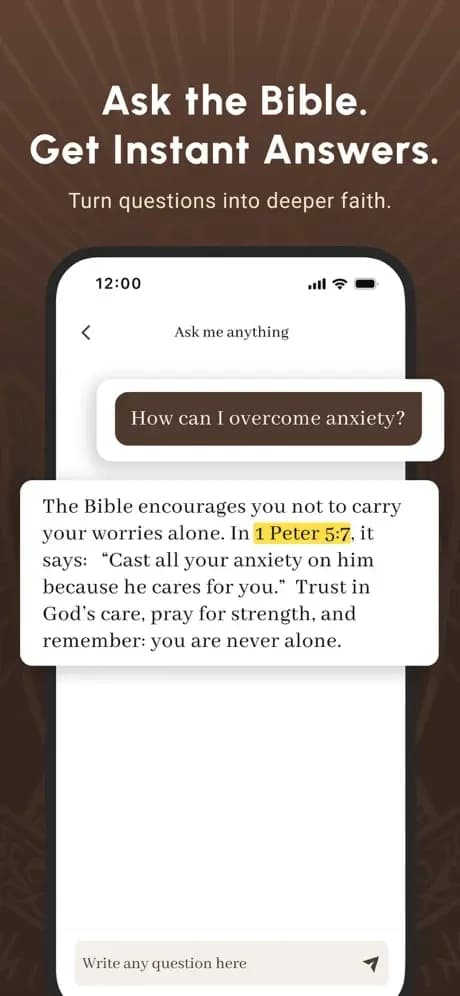
One honest caution belongs here: AI output can be wrong. Treat every answer as a starting point, check it against the passage itself, and take weighty questions to trusted Christian community, the same way you would with any study aid. Bible Note can hold your context and your questions; discernment stays with you and the people you trust. If choosing an app is your next step, our Bible study app guide compares several study workflows in more detail.
Frequently asked questions
Where should a beginner start reading the Bible?
A Gospel is a common and workable starting point. Mark is short and fast-moving, while Luke gives a longer, connected account of Jesus' life and teaching. Philippians is another good first book if you would rather begin with a brief letter. Choose one book, read it in natural units, and stay with it until you finish.
Should I read the Bible cover to cover?
Reading from Genesis to Revelation is an excellent long-term goal. For a first sustained rhythm, many readers begin with a Gospel or a short letter, where they can meet a complete literary unit and gain confidence in reading context. A cover-to-cover plan can become a meaningful next step when you are ready for it.
How much should I read each day?
Aim for one natural unit: a paragraph, a scene, a speech, or a short psalm. For many people, that takes ten to fifteen minutes. The finished units add up over time and can carry you through a whole book.
What should I do when a passage confuses me?
Write the confusing part down as a question in your own words, then keep reading. Many questions become clearer as the book continues. For the ones that remain, check the surrounding paragraphs, ask a trusted Christian friend or pastor, or use a study tool that shows its sources. A confusing passage is a normal part of reading, and your written question gives you a helpful place to return.
Sources
BibleProject, How to Read the Bible resources, accessed August 19, 2026.
Bible Note, Bible Study Chat and Bible Reading Plan Generator feature documentation, accessed August 19, 2026.
Editorial status
Written and edited by Hans Keller for Bible Note. Sources, Scripture context, dates, and practical limitations are checked before publication.

About the author
Hans Keller
Editorial & Content Lead
Bible Study & Sermon Learning Content Editor
Hans helps Christians turn sermons and Scripture study into clear notes, thoughtful questions, and faithful next steps.
His work helps listeners and group leaders carry a sermon or study beyond the meeting: back to the passage, into clearer questions, and toward one practical response for the week.
Read with Scripture open
Use this guide alongside the full biblical passage and the practices of your local church. Interpretive details can differ across Christian traditions.