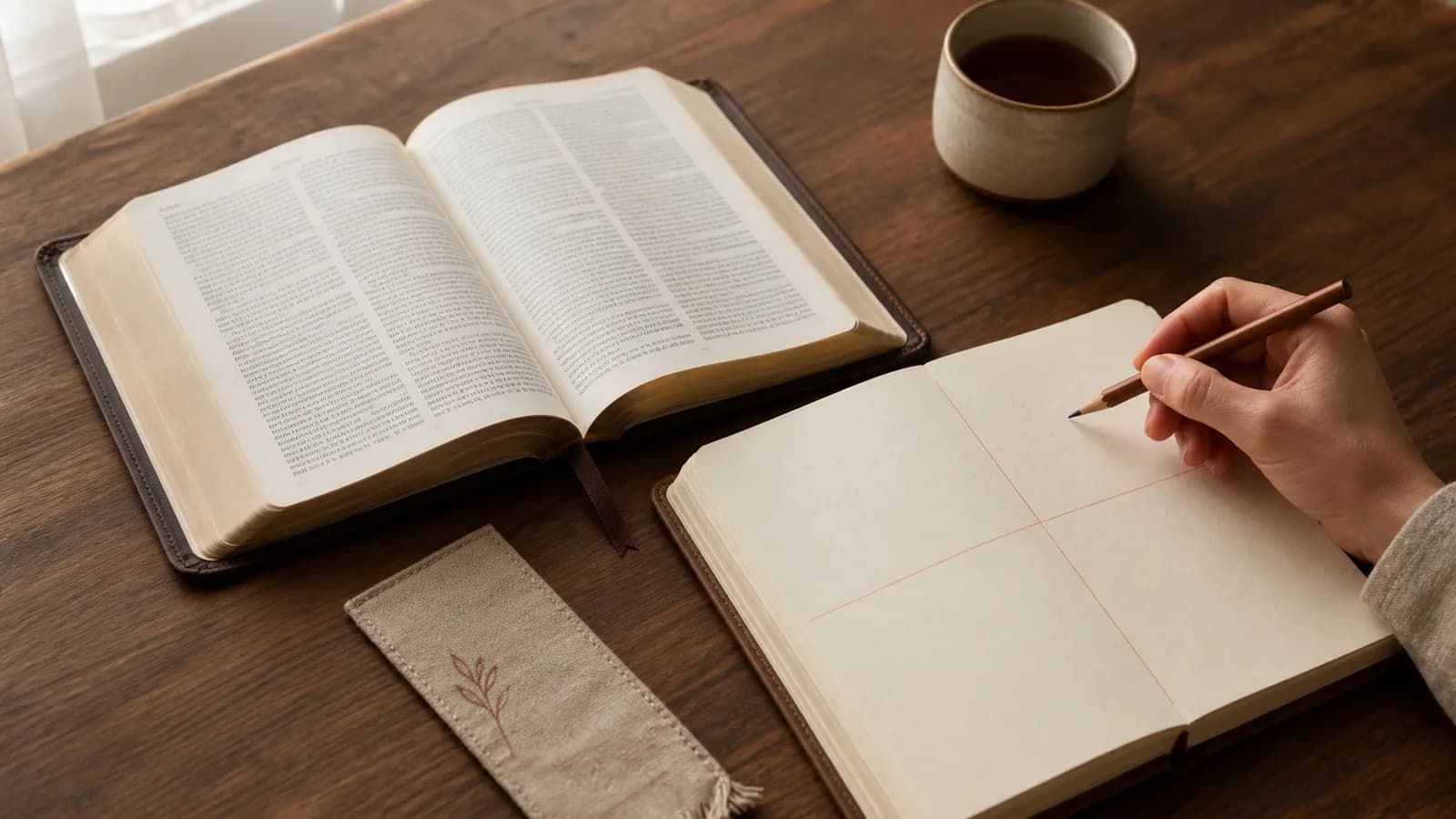


A kettle hums in the kitchen, the house is quiet for a few minutes, and a verse you read yesterday is still sitting with you. You would like to keep it. The question is how to memorize Bible verses in a way that keeps the words connected to what the verse actually says.
The method is simple: choose a verse with its surrounding context, learn it in short speakable pieces, recall it before you look at the page, and return to it on a calm schedule. Each step below works with a paper Bible and an index card. An app can help afterward, once the practice itself is clear.
Choose a verse with its surrounding context
Start with a verse you have already met in real reading. A line from a psalm you prayed through, a sentence from a letter your small group is studying, or a phrase from Sunday's passage will hold your attention well because you have already spent time with it.
Keep the verse short enough to say in one or two breaths. A single sentence, or a self-contained part of one, is a good size for a first attempt. You can add the neighboring sentence later, once the first piece is steady.
Before you begin memorizing, read the paragraph the verse lives in. Notice who is speaking, who is being addressed, and what the sentences around it are doing. That surrounding shape is part of what you are learning.
If you do not have a verse in mind, the random Bible verse generator offers a gentle starting point. It provides KJV and WEB passages, and its Show context control opens the nearby verses so you can read the passage in place before deciding whether to keep it.
Step 1: Read the verse until you can explain its place
Begin by learning what the verse is doing in its paragraph. Spend your first sessions reading, slowly and aloud, until you can answer a few plain questions without notes.
Read the whole paragraph once, then read the verse itself several times at an unhurried pace.
Name who speaks or writes, who is addressed, and what the verse responds to.
Say in one sentence, in your own words, what the verse contributes to its paragraph.
Notice any words that carry weight, repeat, or turn the thought in a new direction.
Write a short context note you could glance at later: the situation, the speaker, and the verse's role.
That last note is worth the minute it takes. When you revisit the verse later, it reminds you why the words were worth keeping. If you already keep study notes, the Bible note method pairs naturally with this step, since a saved observation and a saved question give the verse a home beyond the card.
A context-first quality check
Test yourself with two questions before moving on. Can you explain where the verse sits in its book and paragraph without opening the page? And does your one-sentence summary match what the surrounding verses actually say? If either answer is shaky, read the paragraph again slowly before you start reciting.
Step 2: Break the verse into speakable pieces
Long verses become manageable when you divide them into phrases you can say comfortably. Most verses fall into three to six natural pieces, following their own punctuation and rhythm.
Mark the verse at its natural pauses, where a comma, a turn of thought, or a breath would fall.
Read the first phrase aloud several times until it comes easily.
Add the second phrase, then say the first and second together from memory.
Keep adding one phrase at a time, always returning to the beginning before adding the next.
Once the whole verse flows, say it start to finish a few times without looking.
Returning to the beginning each time keeps the verse connected. The early phrases get the most repetition, and you practice arriving at each new phrase from the words that lead into it.
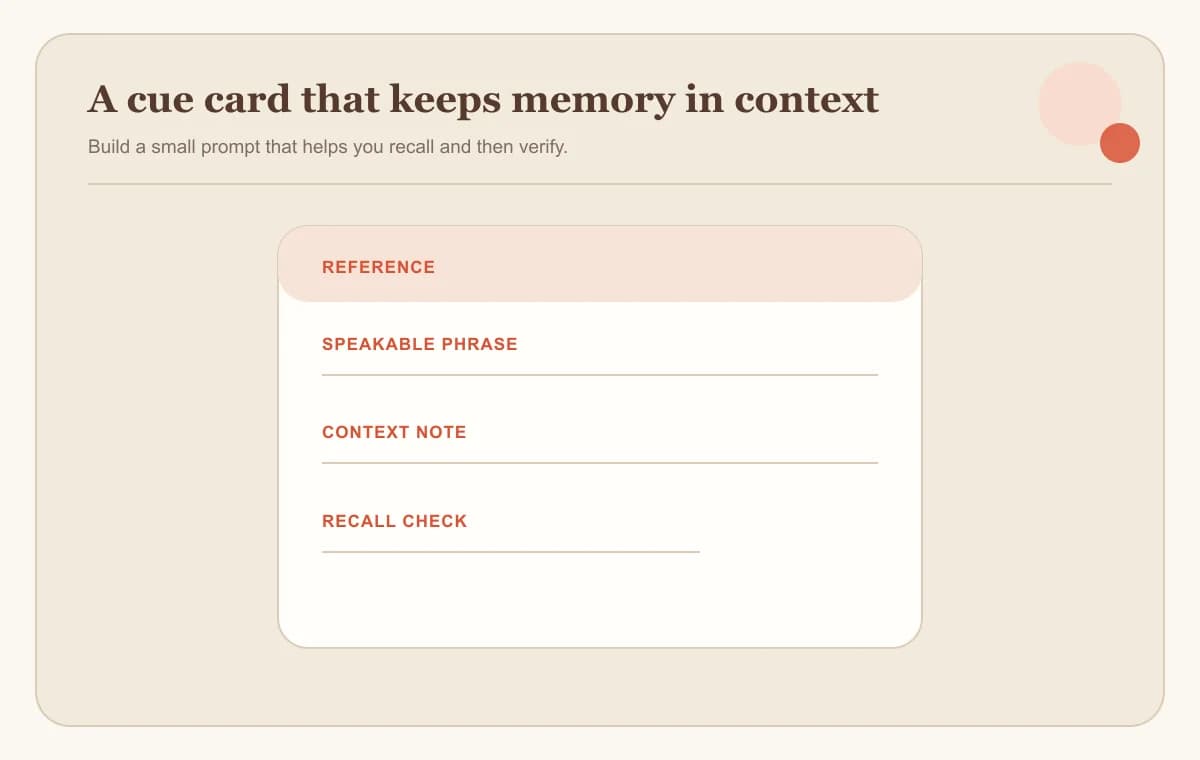
A small card helps here. Write the verse's location on one side and the verse itself on the other, with your context note underneath. Keep the card where you will see it: beside the kettle, in a pocket, on the desk.
Step 3: Recall it before you look
The heart of the practice is the attempt to remember. Read the verse, look away from the card, and try to say it; the attempt reveals which phrase needs another look. Checking afterward shows you exactly where to spend the next few repetitions.
Look away from the text and say the verse aloud from beginning to end.
Open the card and check your wording against the text, phrase by phrase.
Mark the places where you hesitated, substituted a word, or lost the order.
Say the verse again from memory, giving extra attention to the spots you marked.
Stop while the verse still feels fresh, and let the next session do its part.
Check the wording carefully, especially in the early sessions. When you find a substituted word, say the accurate phrase a few times before moving on, so the next attempt starts from the correct wording.
A modest review rhythm
Try returning to the verse later the same day, the next day, and again later in the week. If you would like to keep the verse beyond that, revisit it now and then; an occasional return fits easily into ordinary reading time.
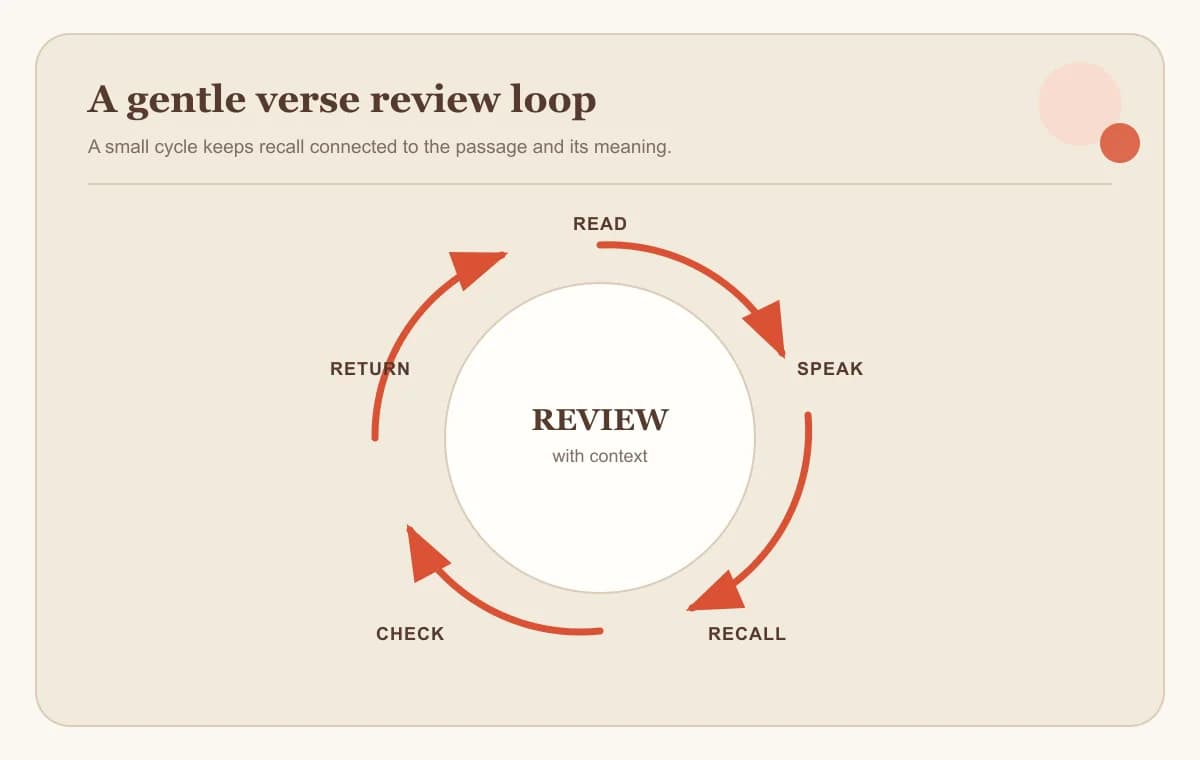
When a review goes badly, treat it as information: return to the phrase step for that verse, context note in view, and give it a few more unhurried repetitions.
Step 4: Carry the verse into a real moment
This last step moves the verse from the card into ordinary life.
Choose one real situation where the verse belongs: a morning prayer, a walk, a moment of worry, a conversation you anticipate.
When that moment arrives, say the verse slowly, in prayer or under your breath.
Notice what the verse's context adds to the moment, and what the moment adds to the verse.
Jot a sentence afterward about how the verse met the situation, and save it with your context note.
When you say the verse in prayer or reflection, keep its context in view: the speaker, the situation, and the hope the passage was carrying.
Keep expectations modest. Memorization is one way of keeping Scripture near. It works alongside reading, study, and the life of a church community, as one faithful practice among several.
Use Bible Note for context and gentle review
Once the practice itself feels natural, Bible Note can hold the verse and its context in one place. Save the passage, keep your context note beside it, and return to it at a pace you can keep.
The app's own prompt describes a saved verse as something you can revisit and turn into devotionals and flashcards. If you like working from cards, a flashcard made from your verse supports the recall-before-you-look habit, and keeping the passage saved with your context note gives you a familiar place to check the wording.

When a verse raises a question you cannot answer from the paragraph alone, Bible Note Bible Study Chat lets you ask from the passage itself. Treat its responses as a starting point: open the cited text, weigh it in context, and bring weighty questions to trusted teachers and your church community.
The app can hold the passage and the note. The reading, the speaking, and the carrying remain yours, and that is where the practice happens.
Common memory mistakes to avoid
A few habits quietly undo good effort.
Memorizing a verse you have never read in context
A verse picked from a list and drilled the same day has nothing to anchor it. Read the paragraph first, so you know who is speaking and what the words respond to before you start reciting.
Adding new verses before old ones are steady
It is tempting to start a new verse every day. A slower pace leaves room to revisit the verses you have already begun, so consider taking one new verse at a time.
Reciting without checking the wording
Repetition can rehearse errors as easily as it rehearses the text. Check your recall against the actual wording regularly, and when you find a substitution, say the accurate phrase a few times before moving on.
Letting review lapse after the verse feels learned
A verse you learned well still benefits from an occasional return. If you want to keep a verse available, revisit it now and then, even once a month.
Frequently asked questions
How long does it take to memorize a Bible verse?
There is no fixed timeline. Work through the steps in short, unhurried sessions, check your wording as you go, and let the verse set the pace.
How many verses should I memorize at once?
One verse at a time is a simple starting pace. When a verse is coming along comfortably, you can begin another while still revisiting the first.
Which translation should I memorize from?
Choose the translation you actually read and hear in your church community. Staying with one translation for a verse keeps the wording you are practicing consistent.
What if I keep forgetting a verse I already learned?
Return to the phrase-by-phrase step with the context note in view, and give the verse a few extra sessions. Rereading the paragraph can also help you reconnect the words to their setting.
Sources
Editorial status
Written and edited by Hans Keller for Bible Note. Sources, Scripture context, dates, and practical limitations are checked before publication.

About the author
Hans Keller
Editorial & Content Lead
Bible Study & Sermon Learning Content Editor
Hans helps Christians turn sermons and Scripture study into clear notes, thoughtful questions, and faithful next steps.
His work helps listeners and group leaders carry a sermon or study beyond the meeting: back to the passage, into clearer questions, and toward one practical response for the week.
Read with Scripture open
Use this guide alongside the full biblical passage and the practices of your local church. Interpretive details can differ across Christian traditions.