

If you are learning how to meditate on the Bible, picture this: the chair by the window is quiet, the coffee is still warm, and the Bible is open to the same short passage it was open to yesterday. Stay with that passage a little longer than feels efficient: read it slowly in its context, notice what is actually there, ask the questions the text itself raises, pray an honest response, and return to one thought from it later in the day.
That is the whole shape of the practice: a passage, a few unhurried minutes, and a willingness to let the text set the pace. The steps below walk through each part.
Choose a short passage and keep its context open
Begin small. A paragraph, a short psalm, or a complete scene from a Gospel gives you enough to hold in your mind for a whole day. A single isolated sentence, lifted away from the sentences around it, is much harder to meditate on well, so keep the sentences around it in view as you work.
Choose a passage you can reread in under a minute, then keep the surrounding section open while you work. If you need a place to begin, the random Bible verse generator provides KJV and WEB passages with nearby context, so you can see the verses around the one that drew your attention. Pick one passage and commit to it for the day, or even for the week.
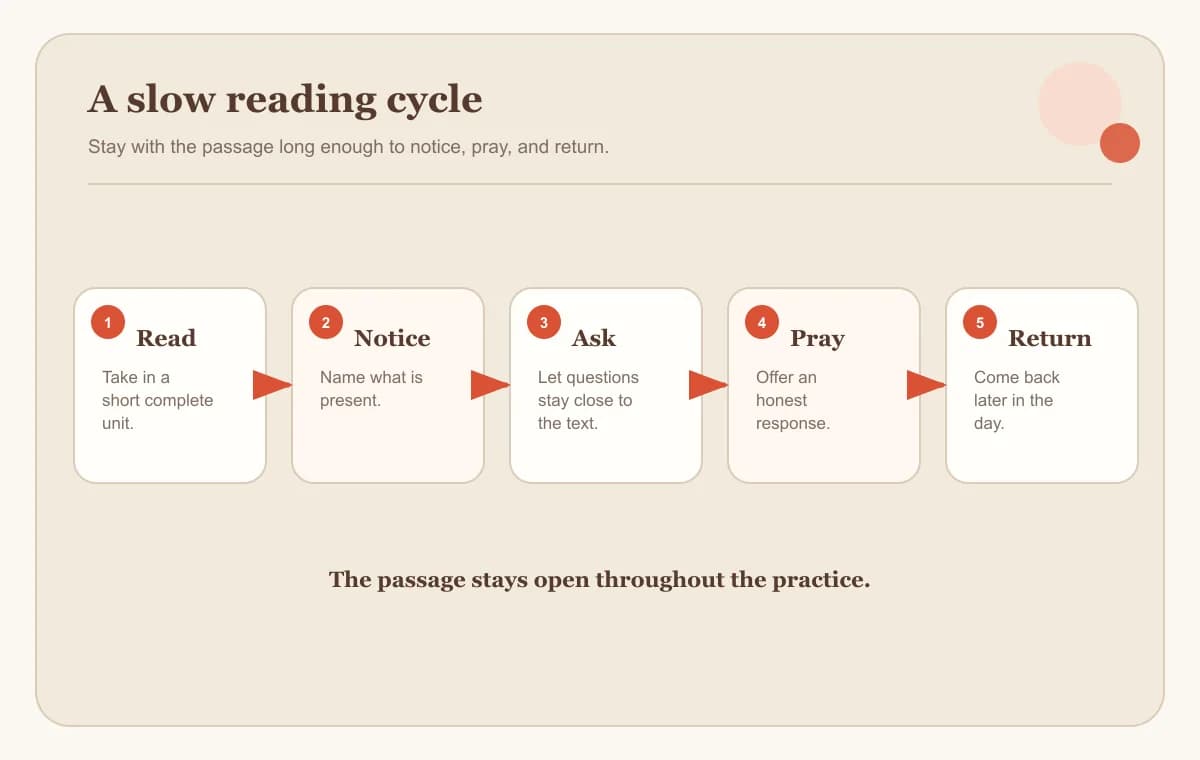
The practice that follows has five parts, and each one gets a closer look in the steps below:
Read the passage slowly, more than once.
Notice the words, movements, and details that are actually present.
Ask the honest questions those details raise.
Pray a response and name one concrete action.
Return to the passage later in the day.
Step 1: Read slowly enough to notice what is there
Speed is the first thing to give up. Most of us read the Bible the way we read everything else, moving quickly toward the point. Meditation asks for a different posture: read the passage once at normal pace, then read it again slowly enough that individual words have time to register.
Give the passage several unhurried readings
Read the passage once to get its overall shape.
Read it again slowly, pausing where a word or phrase catches your attention.
Read it a third time, including the paragraph before and after it.
On the slow reading, listen for repetition, for shifts in tone, for who speaks and who listens. Consider the immediate paragraph around the passage and the kind of writing it is, whether narrative, poetry, letter, or teaching. Notice the details another careful reader could point to in the same words. An observation like “this paragraph repeats the idea of waiting” gives you something solid to carry; an observation like “this makes me feel peaceful” is fine as a reaction, and it becomes more useful when you can say which words prompted it.
Silence helps here. Put the phone face down and let the reading be the only thing happening. By the end, you should know what the passage says, in context, well enough to summarize it in a sentence or two of your own.
Step 2: Turn observations into honest questions
Once you have noticed what is present, let those observations become questions. Good meditation questions are shaped by the text: they send you back into the passage and its context for an answer, and they admit honestly what you do not yet understand.
Ask questions the passage can bear
A few stems that work with almost any passage:
Why does this word, image, or action appear here?
What changes between the beginning and the end of this section?
What kind of writing is this section, and how does the immediate paragraph frame it?
Which detail keeps drawing my attention, and what might it be connected to?
What does this passage assume about God, and about the people hearing it?
Write one or two of these down, even in the margin. Some questions will resolve as you reread the surrounding paragraph. Others will stay open, and an open question is a good companion for the rest of the day. It gives your mind something specific to return to, anchored in the text, and a specific question lasts longer than a vague impression.
Step 3: Respond in prayer and one concrete action
The next step in this guide is prayer, offered as an optional way to respond. After reading and questioning, you can speak to God about what you have actually seen in the passage: gratitude for what it shows, confession where it exposes something, a request where it leaves you in need. Keep the prayer tied to the text. A prayer that begins “I noticed this, and here is what it stirs in me” stays specific to the passage in front of you.
Write the response where you will see it again
Record three short things before you close the book: the passage you read, one observation that mattered, and the prayer or response that followed. Then name one concrete action, small enough to actually do today. A concrete action might be a conversation to approach differently, a habit to pause, a person to encourage, or simply a decision to reread the passage before bed.
If you already keep written reflections, the Bible note method pairs naturally with this step: its pattern of passage, observation, question, and response gives your meditation a durable written form. A structured approach like the SOAP Bible study method can serve the same purpose when you want a fuller worksheet for the session.
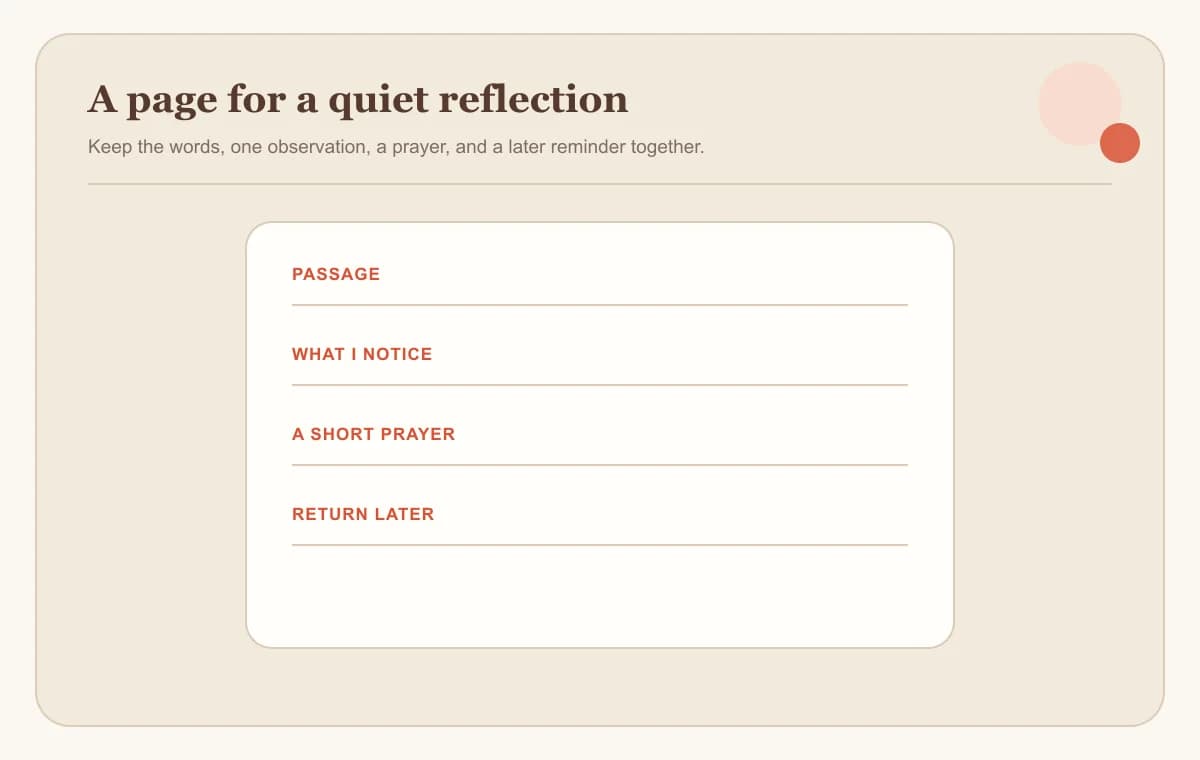
Keep the action modest. Choose one small, truthful response you can actually carry into an ordinary afternoon.
Step 4: Return to the passage later in the day
The return is what turns a one-time quiet reading into meditation. Choose one thought from the morning: a phrase, an observation, or the question that stayed open. Carry it with you and revisit it at a set moment, during a lunch break, on a commute, or before sleep.
When you return, ask two things. Does the thought still hold up against the passage as you remember it? And what has the day shown you about it? An afternoon of ordinary life can add texture to a passage; a line about patience may read differently after a slow queue and a hard conversation.
Keep the return light. You do not need a second full session. Reread the passage if it is nearby, or simply recall the one thought and let it reframe the moment you are in. End the day by noting, in a sentence, what the return added. That sentence becomes tomorrow's starting place.
Use Bible Note to keep a quiet reflection together
Bible Note offers an optional path that describes saving a verse, revisiting it, and turning it into a devotional or flashcards. Its random Bible verse tool can show KJV and WEB verses with nearby context. If you use it, save the passage you are meditating on and keep your observation and prayer beside it in one note.
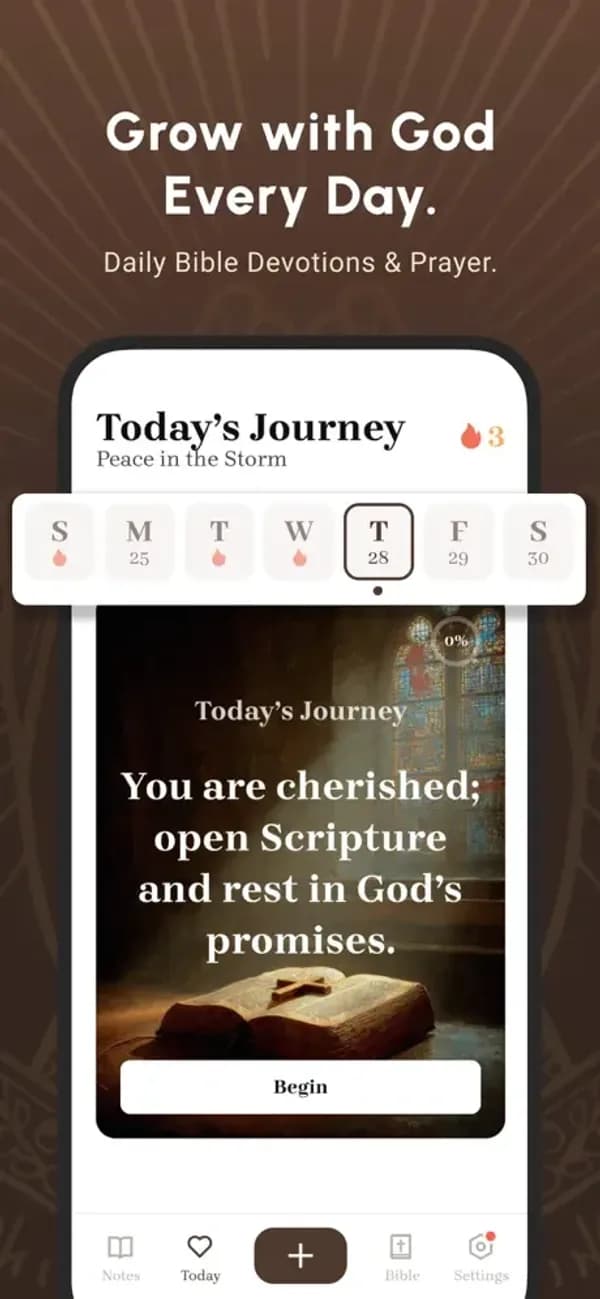
Treat the app as a place to store the written part of this practice. The meditation itself happens in the unhurried reading, the honest questions, and the prayer. Bible Note does not replace Scripture, prayer, a pastor, church community, or your own judgment.
Common meditation mistakes to avoid
A few habits quietly drain this practice of its value.
Starting too long. A full chapter invites skimming. Choose a passage short enough to reread slowly, and lengthen it only when the habit is steady.
Leaving the context closed. A single verse apart from its paragraph is easy to bend toward whatever you already think. Keep the surrounding section open and let it correct your first impressions.
Rushing to application. If you decide what the passage means for your life before you have noticed what it says, the meditation becomes a mirror. Let observation and questions come first.
Treating prayer as a summary. Prayer after meditation is a response, addressed to God, about what you actually saw. Keep it distinct from a restated outline of the passage.
Skipping the return. The later revisit is where the passage meets the day. Set a specific moment for it, because an unplanned revisit is easy to lose.
Expecting a guaranteed experience. Some mornings feel rich and some feel dry. Keep doing the concrete steps and let each session be what it is.
Frequently asked questions
How long should I meditate on a Bible passage each day?
Ten to fifteen unhurried minutes is enough for a short passage: a few slow readings, a question or two, and a brief prayer. A short session you actually keep is easier to sustain than an occasional long one.
What passage should I start with?
Start with whatever you are already reading, a short psalm, or one complete paragraph from a Gospel. Choose something you can reread in under a minute, and stay with the same passage for several days before moving on.
Is biblical meditation the same as general mindfulness meditation?
This guide uses the term in a simple way: reading a short passage attentively in its context, asking honest questions about it, and writing or praying a response. Other traditions use the word in their own ways; here it names only the practice described above.
What if I do not feel anything when I meditate on Scripture?
That is normal and common. A quiet or dry session can still include the same concrete actions: read slowly, write one observation and one question, and pray a short response. If a question or dryness persists, bring it to a pastor or a trusted Christian friend.
Sources
Editorial status
Written and edited by Hans Keller for Bible Note. Sources, Scripture context, dates, and practical limitations are checked before publication.

About the author
Hans Keller
Editorial & Content Lead
Bible Study & Sermon Learning Content Editor
Hans helps Christians turn sermons and Scripture study into clear notes, thoughtful questions, and faithful next steps.
His work helps listeners and group leaders carry a sermon or study beyond the meeting: back to the passage, into clearer questions, and toward one practical response for the week.
Read with Scripture open
Use this guide alongside the full biblical passage and the practices of your local church. Interpretive details can differ across Christian traditions.