

It is a quiet evening, the Bible is open to a short paragraph, and the notebook beside it is still blank. The question at that moment is rarely "How do I study the whole Bible?" It is smaller and more practical: which Bible study method should I use for this passage, tonight?
The honest answer is that several good methods exist, and each answers a different question. One slows you down to see what the text actually says. Another gives a compact written pattern you can repeat daily. A third organizes confusion into questions worth chasing. A fourth turns reading into notes you can find again next month. Choosing well means matching the method to the passage in front of you and the time you have this week.
A good place to begin costs nothing and needs no app: pick one short passage, read it twice, and write down three things you can point to in the text. That single habit sits underneath every method in this guide, and it will tell you quickly which kind of structure you need next.
Start with the question you need your method to answer
Most frustration with methods comes from asking one tool to do another tool's job. Before you choose, name the question you are bringing to the passage.
"What does this text say?" You need a method that slows you down and keeps your eyes on the words, the people, and the movement of the passage.
"What should I do with this?" You need a method that ends in a concrete response, small enough to recognize on an ordinary Tuesday.
"What confuses me here?" You need a method that treats questions as the main material of the study and gives them somewhere to go.
"How do I remember this later?" You need a method that produces a record you can return to, search, and build on over time.
A faithful study will eventually touch all four questions. The point of choosing a method is to give one of them your full attention today, so the passage gets a careful, unhurried reading.
Four Bible study methods worth trying
The four approaches below overlap in spirit and differ in emphasis. Each one fits on a single page of notes.
Observation, context, and application
This is the broadest pattern: look carefully at the passage, place it in context, and name a response. You read the paragraph, notice what is actually there — repeated words, contrasts, commands, changes of speaker — then read the paragraphs around it, and only then decide what the passage asks of you.
Choose this approach when you want a flexible framework that works with any genre of Scripture. It carries no fixed form, so it asks more judgment of you and rewards readers who like to think in paragraphs and whole scenes.
SOAP: a compact written pattern
SOAP stands for Scripture, Observation, Application, and Prayer. You record the reference, gather details you can point to in the text, name one practical response, and answer God in a short written prayer. Its strength is size: a complete entry fits in ten quiet minutes, easy to repeat day after day.
If this pattern sounds like the right fit for your routine, the SOAP Bible study method guide walks through each step with an example you can adapt.
Question-led study
Question-led study treats your confusion as the starting material. You read the passage once, write down every honest question it raises — about words, people, motives, background, or meaning — and work through them one at a time, returning to the text and its context for evidence.
Choose this approach when a passage puzzles you, when you are preparing for a discussion, or when your reading has become too comfortable. Its main discipline is honesty: the questions must come from the text, and the answers must return to it.
A structured note method
A structured note method gives every study session the same durable shape: the passage reference and translation at the top, observations in one place, open questions in another, and a response or prayer at the end. The structure itself is the method: it turns scattered reading into a growing record you can revisit.
Choose this approach when your concern is continuity — when you want next month's self to be able to find, understand, and build on what you studied today.
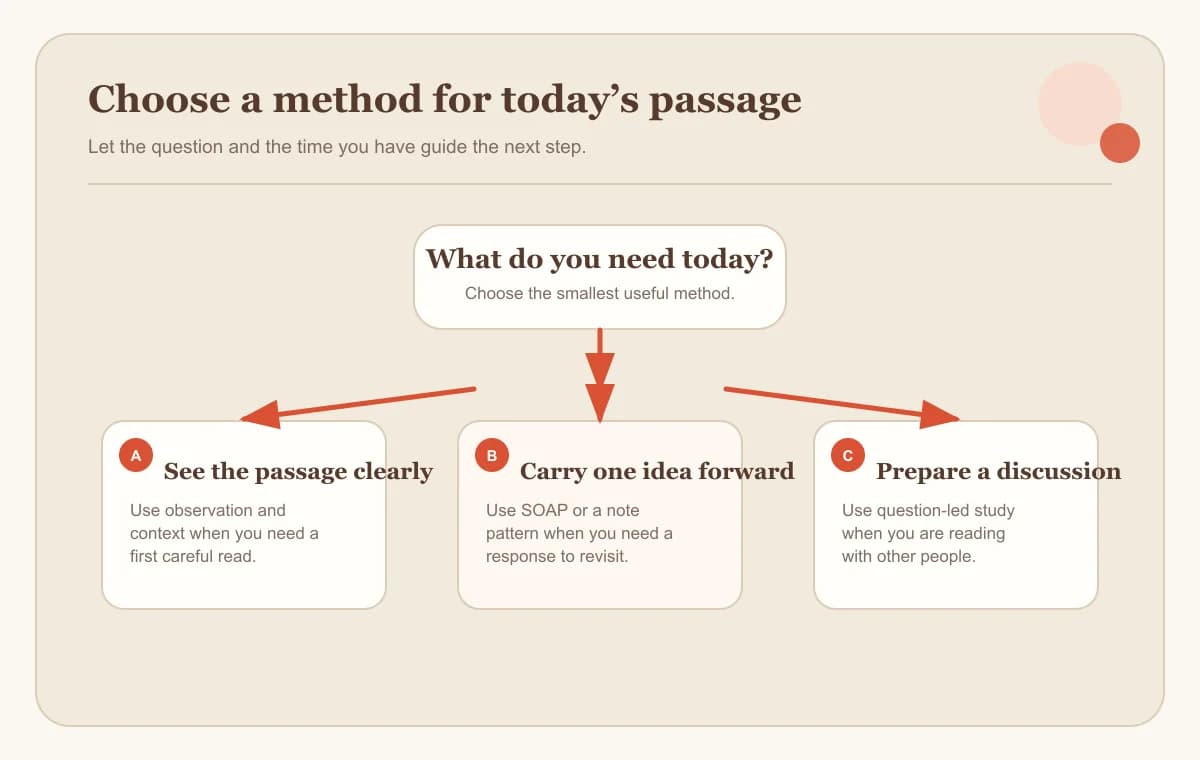
Choose a Bible study method for this week’s passage
With the four options in view, a simple if/then chooser can settle the decision for the passage you plan to read this week:
If you have twenty unhurried minutes and a narrative passage, then use the broad observation, context, and application approach and let the whole scene guide you.
If you have ten minutes and want a daily habit, then use SOAP and keep each entry small enough to repeat tomorrow.
If the passage confuses you or you are preparing for a group, then use question-led study and write the questions before you chase any answers.
If you keep losing track of what you studied last month, then use a structured note method and give every session the same shape.
If you are still unsure, then start with SOAP for a week; its four parts will show you which kind of structure you reach for naturally.
Two cautions keep this chooser honest. Commit to one method for at least a week before judging it, because every method feels stiff on day one and natural by day five. And let the passage set the size: a short psalm and a dense chapter ask for different amounts of time, and no method changes that.
Use one shared sequence inside every method
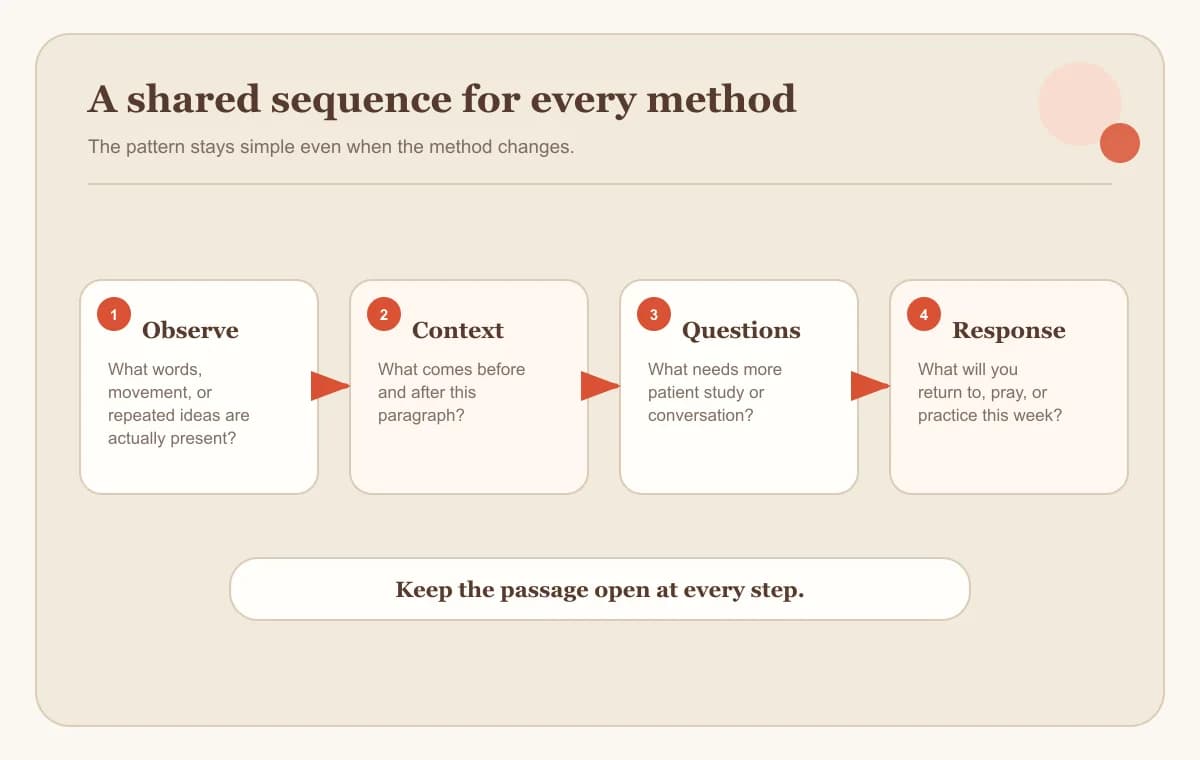
Underneath these four methods runs one shared sequence: observation, context, questions, response. Whatever method you choose, the sequence keeps your study anchored in the text.
Observation. Read the passage and write down what an attentive reader can point to: repeated words, commands, contrasts, people, actions, and turns in the scene.
Context. Read the surrounding paragraphs and note who is speaking, who is being addressed, and what has just happened. Context is where hasty readings get corrected.
Questions. Write the honest questions the passage raises and keep them visible. A question you cannot answer today becomes tomorrow's starting point.
Response. Name one small, concrete response that follows from what you observed — an action, a prayer, a conversation, a habit to change.
The sequence adapts to each method without strain. In SOAP, observation and response already have their own sections, and context work happens before you write. In question-led study, the third step simply moves to the front of the page. In a structured note, each part gets a fixed home, which is what makes the Bible note method so durable across months of reading.
The sequence also travels well into a group. These small-group Bible study questions can help you turn private observations into open questions that invite the whole group back to the text.
Keep a record you can return to
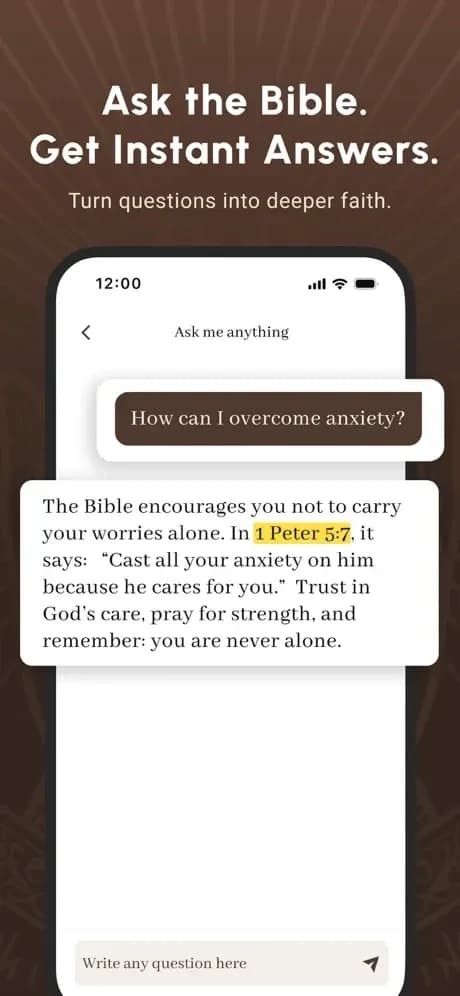
A method earns its keep when you can return to what it produced. This is where Bible Note fits naturally into the rhythm of this guide: Bible Note Bible Study Chat can start from the passage you currently have open or from a sermon note, so the questions from step three of the shared sequence have a place to go the same evening you write them down.
Bible Study Chat answers display Scripture citations with a translation label, and its labels distinguish Scripture, interpretation, and AI inference, so you can see at a glance which kind of statement you are reading. When an answer proves useful, you can save it to a Note alongside the observations and responses you already wrote.
Two habits keep this tool in its proper place. Bible Note is a study companion, and its AI can be wrong; always read the cited verses in your own Bible and let the passage itself have the final word. The record you keep remains yours to test against the text each time you return.
Common method mistakes to avoid
Collecting methods without practicing one. Reading about methods feels like progress, yet the skill grows only inside repeated practice. Choose one, use it for a week, and let repetition teach you.
Skipping context to reach application. A response formed before the context is clear often answers a passage you invented. Give the surrounding paragraphs their due before you decide what the text asks of you.
Writing observations that cannot be checked. "This passage is about God's love" is a conclusion; the observation step calls for something a reader can point to: a repeated word, a command, a change of scene. Keep conclusions downstream of evidence.
Letting questions evaporate. A question scribbled in a margin and never revisited does no work. Give questions a fixed home, and let the unanswered ones set the agenda for your next session.
Treating any tool as an authority over the text. Methods, notes, teachers, and AI assistants all serve the reading of Scripture. The passage remains the standard, and every aid remains open to correction by it.
Frequently asked questions
Which Bible study method is best for beginners?
SOAP is a kind starting point because its four parts are small, written, and repeatable. A week of ten-minute entries shows you which structure you naturally reach for.
How much time should a Bible study method take each day?
Ten to twenty focused minutes serves most short passages well. Let the passage set the size, and let the method flex to fit.
Can I combine two Bible study methods?
Yes, once each method is familiar on its own. A common pairing is SOAP for daily reading with a structured note page for longer-term records. Learn one first so each part of the combination keeps its job.
How do I know if my method is working?
Look at your notes after a week. A working method produces observations you can point to in the text, questions you can still pursue, and at least one response you actually carried out.
Sources
Editorial status
Written and edited by Hans Keller for Bible Note. Sources, Scripture context, dates, and practical limitations are checked before publication.

About the author
Hans Keller
Editorial & Content Lead
Bible Study & Sermon Learning Content Editor
Hans helps Christians turn sermons and Scripture study into clear notes, thoughtful questions, and faithful next steps.
His work helps listeners and group leaders carry a sermon or study beyond the meeting: back to the passage, into clearer questions, and toward one practical response for the week.
Read with Scripture open
Use this guide alongside the full biblical passage and the practices of your local church. Interpretive details can differ across Christian traditions.